Message from Havana: Fidel Castro’s legacy and the Cuban people’s resistance
In the words of Cuba’s President Miguel Díaz-Canel, Cuba’s fight is about defending humanity as a whole.
In the words of Cuba’s President Miguel Díaz-Canel, Cuba’s fight is about defending humanity as a whole.
By Bert De Belder
To mark the 100th anniversary of Fidel Castro’s birth and express our solidarity with Cuba’s battle against the strengthened commercial, financial and energy blockade, I was in Havana to participate in the International Colloquium “Fidel: Legacy and Future” —along with 1,500 other participants from over 63 countries – including 500 Cuban scholars, intellectuals, artists and students.
Fidel Castro was honored as an architect of the struggle for liberation against colonial occupation, exploitation and oppression of the Global South. And for his vision that led to groundbreaking social programs in the areas of education, healthcare and housing, making Cuba—despite a criminal blockade—a beacon of social justice.
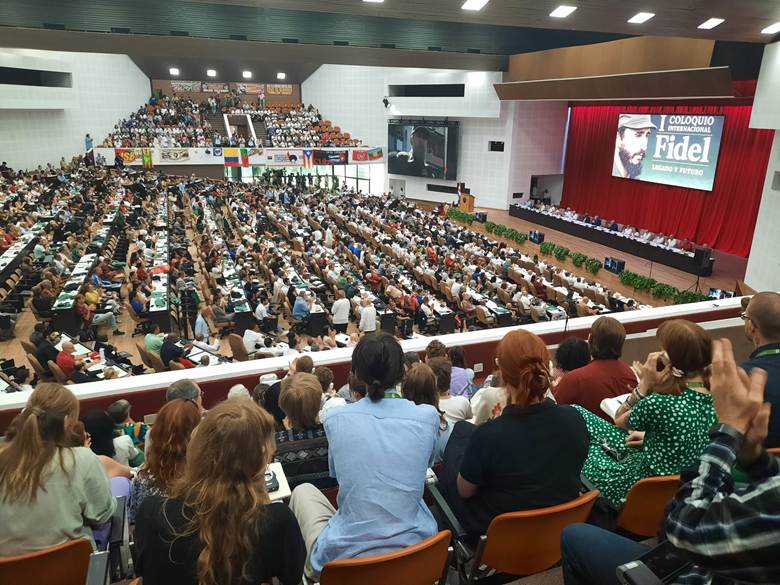
At the Colloquium, we heard the vivid and moving voices of former and current government officials and diplomats from all over the world about Fidel’s vision and its translation into concrete achievements that changed people’s lives. Shows of great respect, gratitude and strong solidarity came from trade unions (including from France (CGT), Italy (CGIL), Australia or Canada), freshly graduated medical doctors at Cuba’s international medical school ELAM, organizations of women, youth and indigenous peoples from every corner of the globe, with large delegations from Latin America (including Brazil’s Movement of the Landless MST), from Africa and from Asia, particularly from the socialist countries Vietnam, Laos and China.
For more than 60 years, Washington has sought to strangle Cuba with an economic, financial, and commercial blockade that is nothing less than economic warfare. This blockade denies the Cuban people access to food, medicine, fuel, and essential technologies—a collective punishment condemned by the international community for mocking international and humanitarian law. Worse, today, this blockade is taking on genocidal proportions with the US military siege and threats of outright intervention by the authoritarian war cabinet of Donald Trump and Marco Rubio.
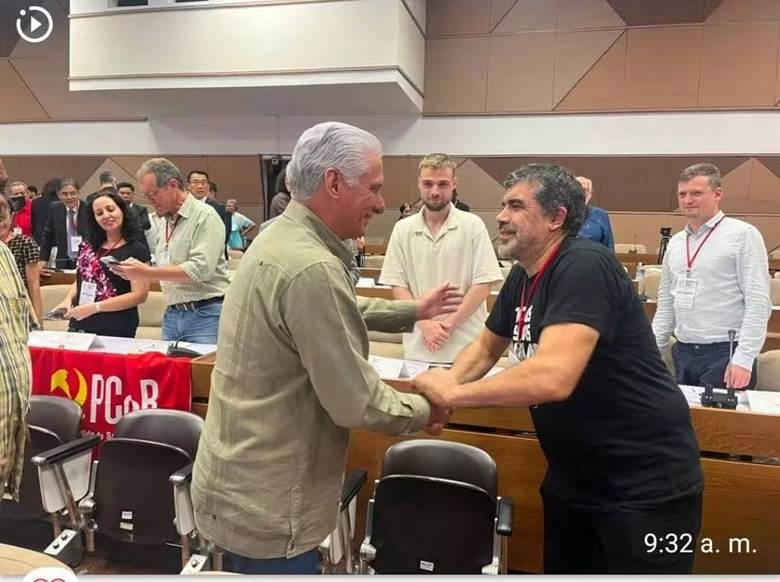
In the face of this, we saw a determined Cuban people, government and Communist Party. The leaders of party and government were present all throughout the debates, conferences and workshops, listening to, discussing with and thanking the audience with great openness and modesty – but also with great determination, unity and mobilization to fight the blockade and “beat the beast”, to resist and to win the battle against US imperialism.
The closing session took place at the famous Karl Marx Theater in the city center, and was a special gift – not to the internationals, but to the common people from Havana, with many workers and families from the neighborhood in attendance – including the95-year old Raúl Castro. The entire evening was a musical, in which the Pioneers (Cuba’s children’s organization) asked the older generations of academics, scientists, sportsmen and women and artists how they should build the future under the new and challenging conditions. Through songs, interviews, stand-up comedy, and a lot of interaction with the excited audience, who spontaneously sang along to the Silvio Rodríguez songs.
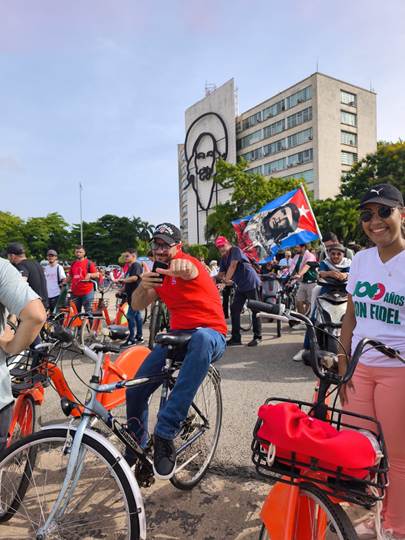
Moving about in our tricycles, we chatted with ordinary Cubans in Havana’s streets, among the fishermen at the world-famous Malecón seafront boulevard, or at the marketplace. They all differed in their opinions of what was worst about Cuba’s dire situation, and on its causes. But no one blamed Fidel – their all-time hero, with most would agreeing that the US blockade has to end.
Cuba’s leadership at all levels lent their ear to the people’s grievances and expectations. They mingled with the workers, the street vendors, the agricultural workers, the youth. They assisted local authorities and mass organizations to find solutions – albeit temporary and ultimately insufficient. Government ministers and party cadre are sent to far-flung provinces to coach local authorities. No, the government and party leaders are certainly not confined to a ‘bubble’ in isolation from their people’s daily reality, they have a hands-on approach to help, to fight, and to win.
They appealed to all present the formation of the largest possible unity to defend Cuba’s – and the world’s – right to defend and build their own homeland and culture, independence, sovereign path of development, and socialism. In the words of Cuba’s President Miguel Díaz-Canel, Cuba’s fight is about defending humanity as a whole. I came back from Cuba with greater rage against the murderous US imperialist, in its Trumpian form, asphyxiation of Cuba. Yet, I was also injected with hope and optimism that Fidel’s legacy is not bygone, but is here to stay, in Cuba and beyond, for today and tomorrow.