Iran won the first battle against the US, but the war is far from over
The US has turned to an attempted blockade of Iran, rather than bombing, precisely because Iran clearly won the first round in the US/Israeli war of aggression against it.
The US has turned to an attempted blockade of Iran, rather than bombing, precisely because Iran clearly won the first round in the US/Israeli war of aggression against it.
By John Ross
Iran has won the first battle in the US war of aggression against it. But it is an error to claim, as some genuinely and rightly against the US aggression have done, that Iran has yet won the war. This is based on an underestimation of the strength and ruthlessness of US imperialism. The outcome of the next round depends on the result of the illegal US blockade of the Strait of Hormuz. This result, in turn, depends not only on the resistance of the Iranian people but also on countries seeking an independent path of development, and the people of the US itself, refusing to accept the US claim to unilaterally control the high seas and blockade any country it wishes.
If Iran has indeed won the war against the US, this would be the greatest strategic defeat of the US since Vietnam, as some have stated—some have claimed, wrongly, that it would be an even greater defeat than Vietnam. But exactly because it would be such a strategic defeat for the US, US imperialism has no intention of giving up simply because it has lost the first round. It, instead, will change its tactics to attack Iran. As the Wall Street Journal bluntly summarised: “As the President said in his first term, the U.S. shouldn’t start a war it doesn’t intend to win. His challenge now is to prove to Iran’s regime he meant what he said.” Activity in solidarity with Iran must be redoubled.
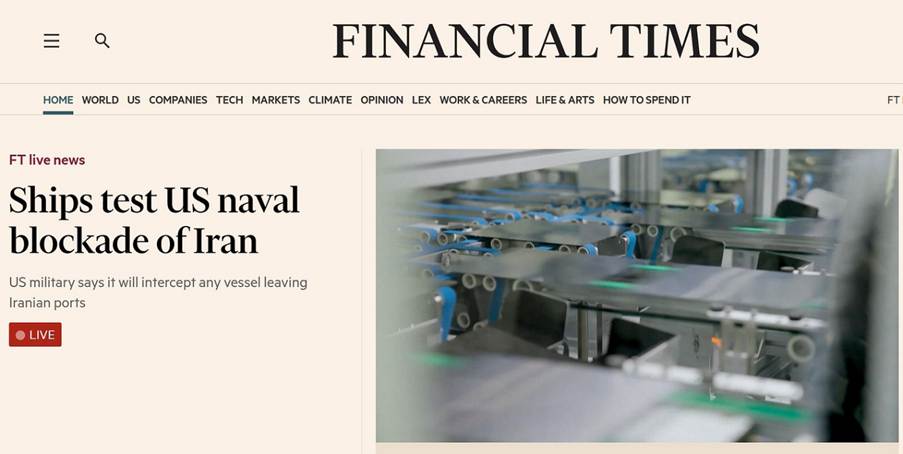
The US has turned to an attempted blockade of Iran, rather than bombing, precisely because Iran clearly won the first round in the US/Israeli war of aggression against it. The reason for the US ceasefire, and the substitution of an attempted blockade, is that the US concluded that it could not domestically withstand the political cost that would have resulted from the almost complete destruction of oil and gas production in the Persian Gulf, and the years-long increase in oil prices in the US that would have followed from it, which would have been the inevitable result of Iran’s military retaliation in the Gulf against a US attack on its power supply and energy production.
Therefore, due to Iran’s military capacity for resistance, the US decided it could not carry out its threat to bomb Iran’s power and energy infrastructure and Trump’s threat that “A whole civilization will die tonight, never to be brought back again”. The US, therefore, chose a different form of escalation—to launch a more prolonged strategy of a war of attrition to try to grind Iran down financially by blocking its oil exports. This policy, however, due to the inevitable months-long high oil and energy prices it would create, attacks in a prolonged way not only Iran, but the economy of every country and the population of the US itself. For this reason, even the US’s closest allies, for example in Europe, have refused to support the blockade.
As the US has switched, for the moment, to an economic war of attrition against Iran rather than a direct bombing attack (this could change at any moment), a key measure is going to be the oil price, as the higher the oil price goes, due to the effect of this in lowering living standards, the greater will be the discontent and opposition in the US to Trump’s war.
At the time of writing, the oil price has risen by 45% since 27 February, the day before the US attack on Iran—the peak since the beginning of the war was 69% on 7 April, before the US and Iran agreed a ceasefire. Due to the oil price increase the US consumer price index rose from 2.4% in February to 3.3% in March—a painful shock for the US population, which largely explains the President’s current low opinion poll ratings. According to the latest YouGov poll, only 39% of the US population was “satisfied” with the President, while 67% believed the country was “on the wrong track”.
But while this energy price increase is extremely painful for the US population it is not by itself enough to cause a deep crisis in the US economy. This is why US financial share markets have not fallen in any major way. This situation is in line with my analyses, published in Chinese at guancha.cn, that the key to the situation in the US is not the economy itself, which at 2% year on year GDP growth, on the latest data is slow, but relatively stable, and not facing a deep crisis, but it is the political impact of these economic processes— see my articles 躁郁症式”分析不可取:什么是决定中美竞争胜负的关键?[‘Bipolar Disorder’ analysis is inadvisable: What is key to determining the outcome of US-China competition?] and 美元低迷就是总统执政失败,特朗普能否打破魔咒?[A weak dollar has signified a crisis for US presidents; can Trump break the curse?]
The political configuration, which faces the US administration, as a result of its latest policy of blockade is therefore the following. The US is attacking Iran, the economies of all countries in the world, and the living standards of the people of the US itself. The more these forces understand their common interests and coordinate their actions, the more certain it is that this US aggression against Iran, but also against them all, will be defeated. Solidarity must be redoubled in that framework.